
Peels That Soften Acne Scarring
A peel that "softens" acne scars is making a promise, and the verb deserves a closer look than a treatment menu gives it.
This page sets that one label against a dermatology source, for New Canaan readers comparing acne scar treatments. It separates what the source supports from what it does not, then ends with questions worth getting answered in writing. For background on the condition itself, keep acne scarring open alongside.
The claim: "softens"
"Softens" sounds like a result, but it names no measure. It does not say how much, how soon, or for which kind of scar. Until a source ties the word to a measurable change, it is marketing language rather than a finding.
The academy's peel sentence
The American Academy of Dermatology describes the treatment in these words:
Chemical peel: Applying a chemical peel to the skin helps the body produce more collagen and elastin.
That sentence describes what a peel prompts in the body. It says nothing about scar depth, scar type, or how visible a scar ends up. A page on chemical peels for acne scars is the natural next source to compare against.
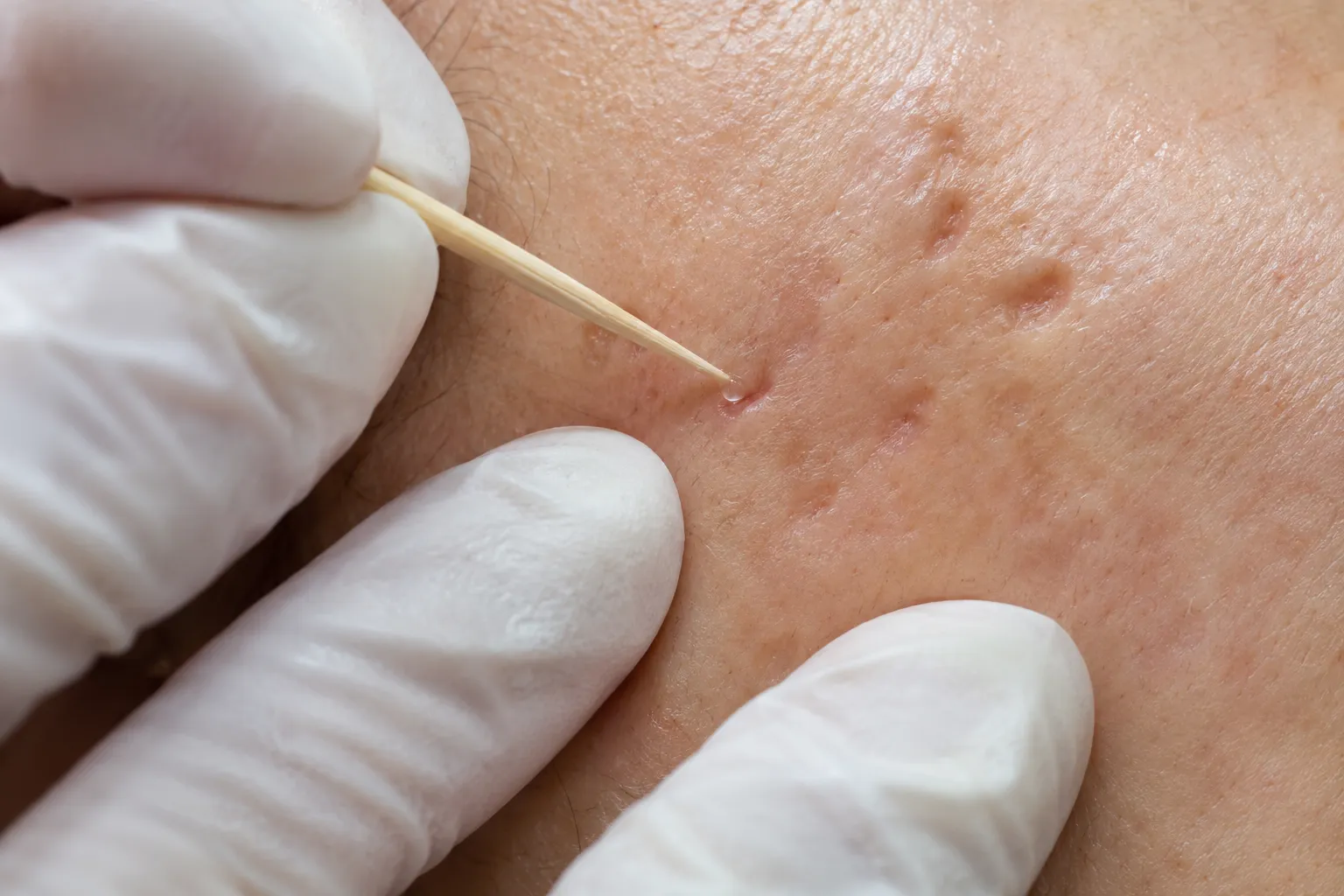
Backed, partly backed, not backed
- Backed: the collagen and elastin mechanism quoted above.
- Partly backed: the word "softens". The mechanism points toward a change in the skin, but the passage does not mention scars or say how large any change is.
- Not backed: a number of sessions, a percentage of improvement, a promise that a scar will disappear, or a statement that a peel suits every scar type. The passage also lists no risks, so any statement about risk needs its own source.
What to ask for in writing
Request the answers on paper, with a publisher named beside each one. Hold them against a page on acne scars before you decide anything.
- Which source the word "softens" rests on, and who published it.
- What measure the clinic uses for "softer", and how it is recorded.
- Which scar types the clinic says a peel suits, with the source for that claim.
- What risks the clinic lists, with the source for each.
A label is a question
Read the label as a question, not a result. If the answers come with a publisher and a measure, you have something to weigh. If they come with adjectives, you have a label. The American Academy of Dermatology also has a page on acne scar consultation and treatment worth reading before you sit down with a clinician. Which treatment fits you is settled in that conversation, not by a menu word.